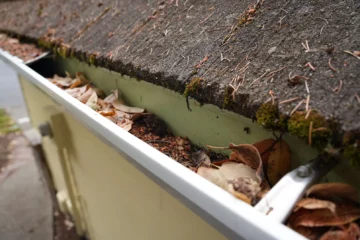

You do not need to climb a ladder to know your gutters are in trouble. Most of the signs that gutters need attention show up from the ground…
IF you know what to look for.
PNW homeowners who catch these early save themselves the cost of water damage remediation. Those who miss them find out the hard way – When your ceiling shows water staining or a foundation crack develops over two wet seasons.
Here are the five signs to look for and what each one actually means for your home.
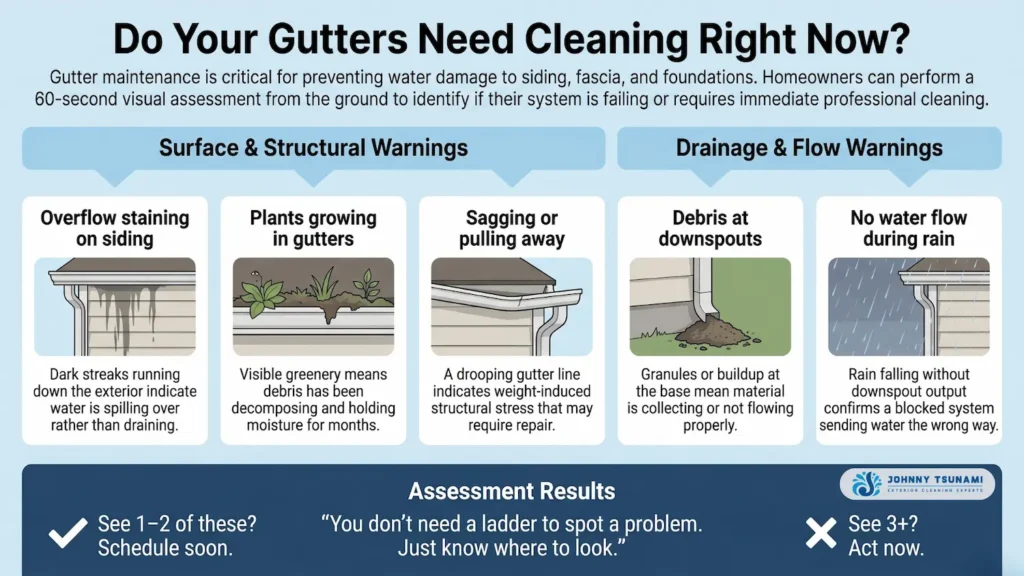
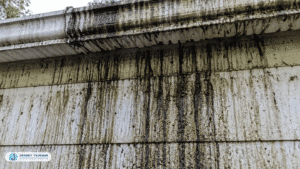
Sign 1: Overflow Staining on Siding or Fascia
Look at the siding below your gutters and at the fascia boards the gutters are mounted to.
If you see dark vertical streaking running down from the gutter line, that is overflow staining. Water that should move through the gutter and down the downspout is instead spilling over the edge and running down the exterior of your home.
Overflow staining tells you two things. First, the gutter carries more water than it can move — which means it is partially or fully blocked. Second, that water runs somewhere it should not. Sustained overflow against fascia boards causes rot. Over time the fascia deteriorates and the gutter loses its structural mounting.
Fresh overflow staining looks dark and wet. Older staining leaves a gray or green residue line along the siding. Either way, it is a clear ground-level signal that the gutter is not functioning.
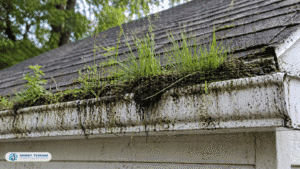
Sign 2: Plants Growing in the Gutter
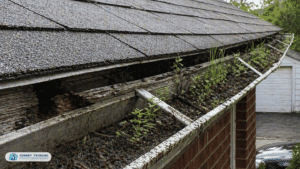
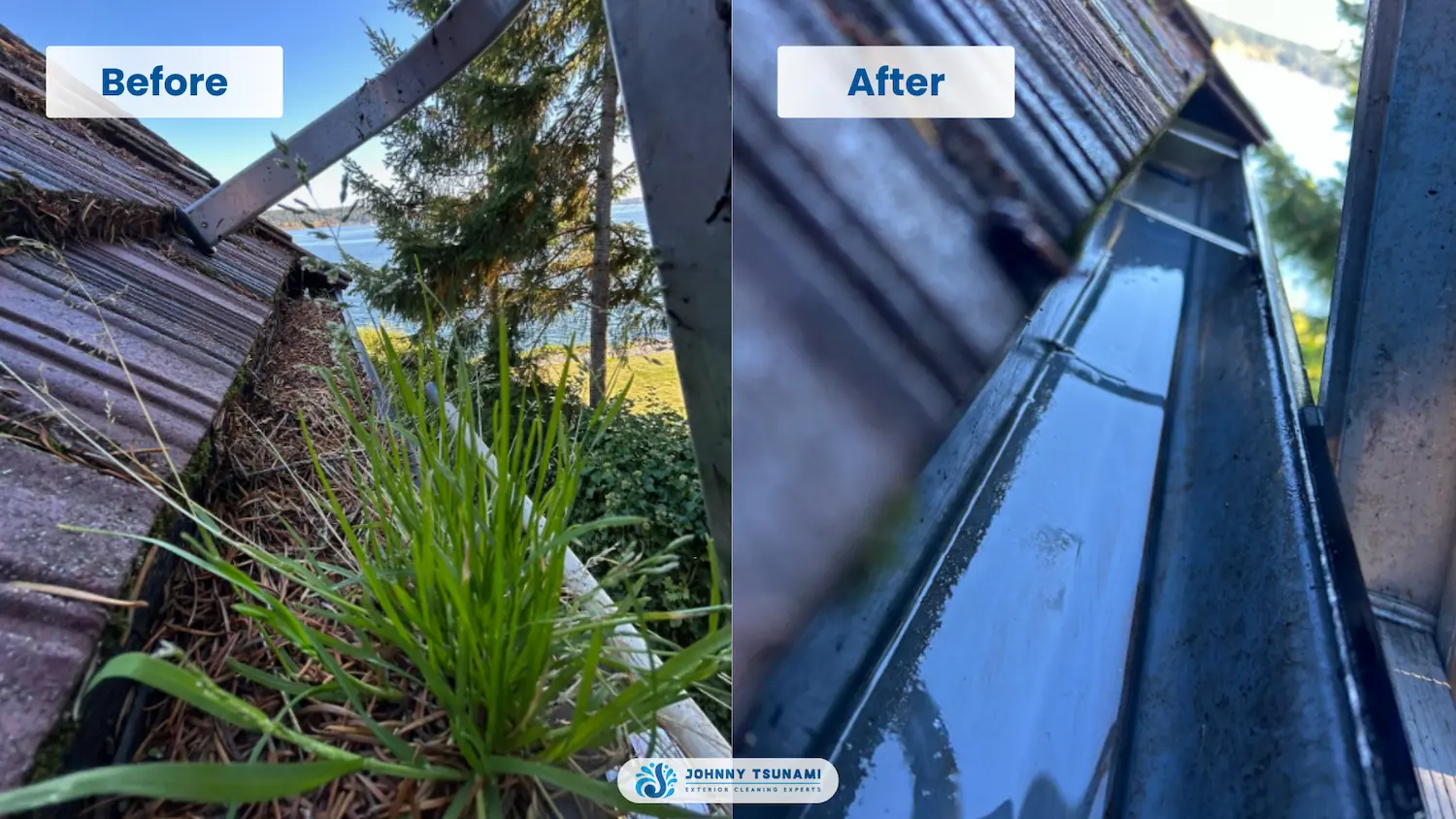
If you can see green growth — grass, weeds, moss, or small plants — emerging from the gutter line, the gutter has been blocked long enough for organic debris to decompose into something that can support plant life.
This is not a borderline case. A gutter with plants growing in it has been blocked for at least one full season. The debris layer holds enough moisture and nutrients to sustain growth. The downspouts are almost certainly blocked as well.
Plants in gutters are common in the PNW because of the combination of organic debris load from evergreen trees and the sustained moisture that keeps that debris wet. A gutter that looked manageable in fall can support visible plant growth by spring if the homeowner never cleared it.
Sign 3: Sagging or Pulling Away from the Roofline
Stand back and look at the gutter line from the side or front of the house.
Gutters carry water, not weight. When debris accumulates and holds moisture, the weight of wet organic material can cause the gutter to sag between mounting points or pull the mounting hardware out of the fascia.
A sagging gutter is a structural problem, not just a cleaning problem. The mounting points have taken more load than they can handle. A gutter that has pulled away from the fascia no longer directs water correctly — it spills it against the foundation of your home.
If you see visible sagging or gaps between the gutter and the roofline, the cleaning conversation may also need to include a repair conversation. A professional can assess the mounting hardware and fascia condition during the service visit.
Sign 4: Granules or Debris at the Base of Downspouts
Walk to the base of your downspouts and look at the ground around the outlet.
If you see a buildup of dark granules, sand-like material, or organic debris around the downspout exit, material flows through the gutter system. Shingle granules — the small protective coating on composition shingles — wash into gutters with every rain and collect at the low points of the system.
A small amount of granules at the downspout base is normal. A significant buildup means the gutters actively collect material and the downspout pushes it through. It also tells you something about the roof: significant granule loss from composition shingles signals shingle aging or previous damage.
If you find no granule buildup at the downspout base despite rain in recent weeks, the downspout has likely blocked and stopped moving water entirely. That is the worse scenario.
Sign 5: No Water Flowing from Downspouts During Rain
This one requires you to observe during or just after a rain event.
Stand where you can see a downspout during active rain. Water should flow steadily from the outlet. If you see water overflowing the gutter edge but nothing coming from the downspout, the downspout has blocked. The water finds an alternate path — over the edge and down the exterior of the home.
Blocked downspouts represent the most structurally significant gutter problem. The gutter itself may be clear, but if the downspout cannot move water away from the foundation, every rain event pushes water somewhere it should not go.
The common paths for that water: behind the fascia, into the soffit, toward the foundation. You won’t see the damage until it is already expensive.
What the PNW Winter Does to Gutters
Pacific Northwest winters put a specific load on gutters.
Four to five months of sustained rain moves material continuously. Evergreen trees — Douglas fir, cedar, hemlock — shed needles year-round but accelerate in fall. Those needles do not break down quickly. They compact into the gutter and hold moisture against the surface underneath.
On top of needle accumulation: deciduous leaf breakdown, seed pods, shingle granules, and organic debris from overhanging branches. By March, a gutter that was clear in October has typically accumulated a significant load.
The combination of organic material and sustained moisture also creates conditions for moss and algae to establish inside the gutter itself. Gutters with active growth are harder to flush and more likely to have partially blocked downspouts.
When to Call vs. When to Wait
If you see signs one or two — overflow staining or plants growing in the gutter — call now. Those are not borderline cases. The gutter has stopped functioning and the risk of water damage grows with every rain event.
If you see sign three — sagging or pulling away — call now and mention the structural concern so the crew can assess mounting hardware and fascia condition during the visit.
Signs four and five are indicators to schedule cleaning in the next few weeks. Not emergencies, but clear signals that the system needs attention before the next heavy rain cycle.
If you do not see any of these signs but your gutters have not been cleaned in over six months, schedule a cleaning anyway. The PNW debris load is significant enough that six months is the recommended interval for most homes.
Frequently Asked Questions
Q: How often should gutters be cleaned in the Pacific Northwest?
A: Most PNW homes benefit from gutter cleaning twice a year — once in late fall after deciduous trees have dropped their leaves, and once in early spring after winter debris has accumulated. Homes with significant evergreen tree coverage may need service three times a year.
Q: What happens if you never clean your gutters?
A: Blocked gutters push water behind fascia boards, into soffits, and toward your foundation. Water damage remediation costs $1,500–$6,000 depending on where the water entered and how long it sat. Gutters that go uncleaned long enough also suffer structural damage including sagging and mounting hardware failure.
Q: Can clogged gutters cause foundation damage?
A: Yes. Blocked downspouts and overflowing gutters direct water toward the foundation rather than away from it. Sustained moisture against a foundation causes cracking, settling, and in severe cases structural compromise.
Q: How do I know if my downspouts are blocked?
A: The clearest sign is water overflowing the gutter edge during rain while no water flows from the downspout outlet. You can also check by running a garden hose into the top of the downspout — if water backs up rather than flowing through, the downspout has blocked.
DIY, Timing & Gutter Guards
Q: Is it safe to clean gutters myself?
A: Single-story gutters with easy ladder access are manageable for most homeowners with the right equipment. Multi-story homes carry significant fall risk and are best left to professionals. Never lean a ladder against the gutter itself — it will deform or pull away from the fascia under the weight.
Q: What is the best time of year to clean gutters in the PNW?
A: Late fall and early spring are the two most important windows. Fall cleaning clears the deciduous leaf load before winter rain moves it into downspouts. Spring cleaning clears the winter accumulation before heavy spring rains hit. If you can only do one, spring is the higher priority.
Q: Do gutter guards eliminate the need for cleaning?
A: Gutter guards reduce debris accumulation but do not eliminate it. Fine debris, needle fragments, and organic material still work through most guard systems over time. Homes with significant evergreen coverage typically still need annual cleaning even with guards installed.
If your gutters have not been cleaned since last fall, spring is the right time.
The debris load from a PNW winter is at its maximum right now. Before heavy spring rains move that material into downspouts and push water toward your foundation, a gutter clean takes the risk off the table.
We serve the Pacific Northwest. A quote takes 60 seconds. No obligation.
[Get a Free Quote] — johnnytsunami.com/quote | Call or text (360) 440-6301