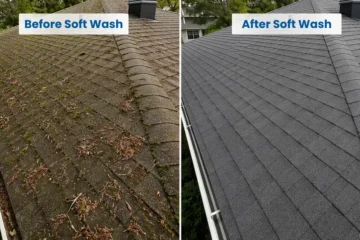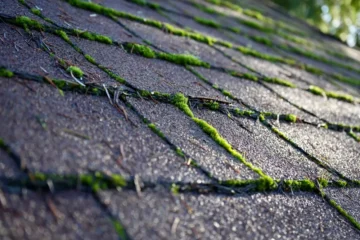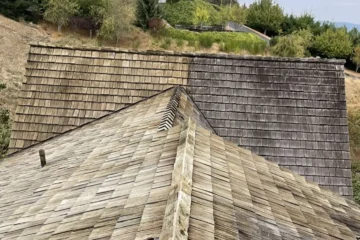

The black streaks running down the shaded side of your roof are alive.
That sounds dramatic, but it’s true. Nerdy scientific talk, incoming…
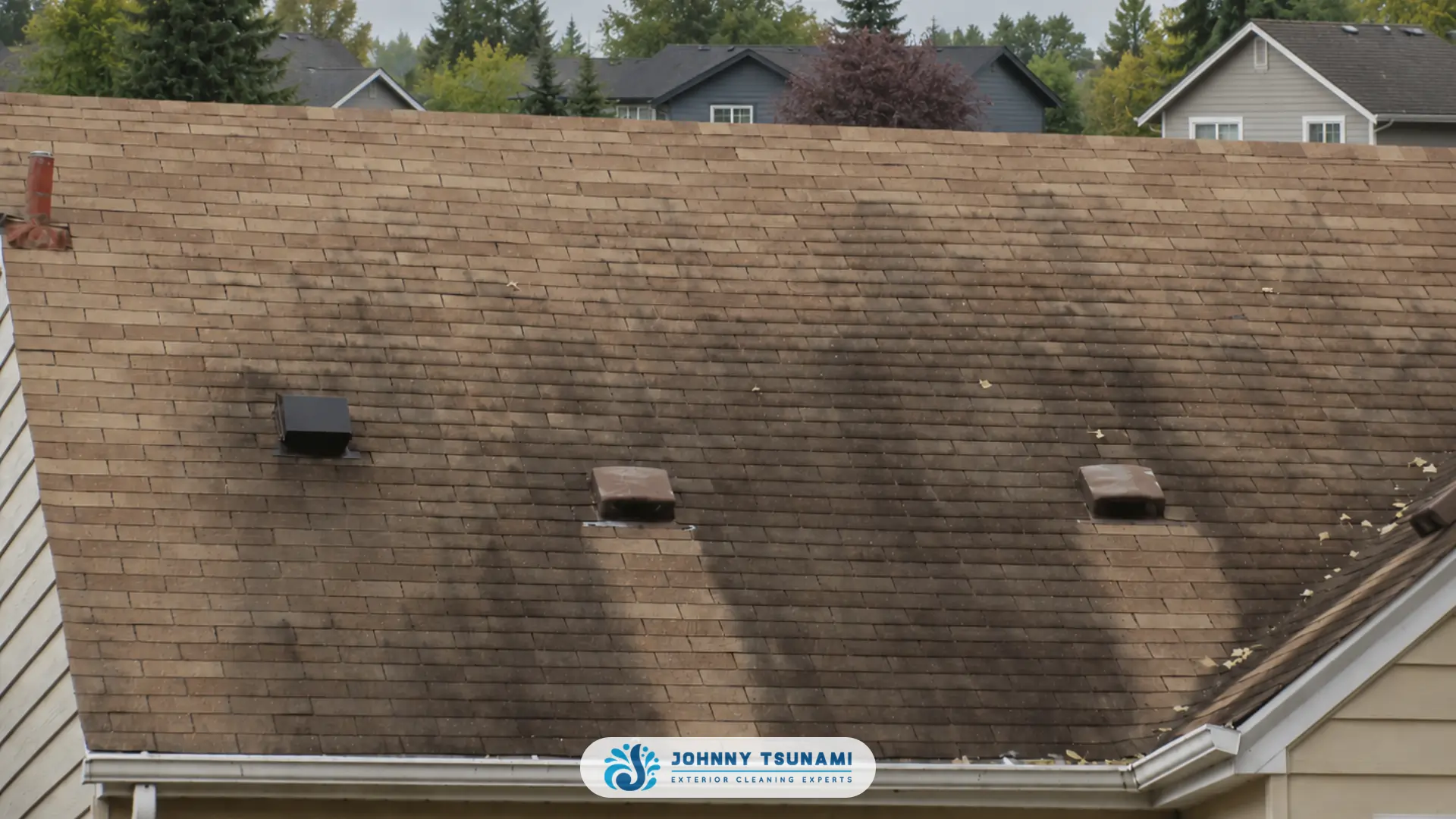
Those streaks most homeowners chalk up to dirt, soot, or weather staining are a single-celled organism called Gloeocapsa magma, a hardy cyanobacteria that’s also (no exaggeration) credited with making life on Earth possible. Woah! More on that in a minute. It sets up on roof slopes that stay damp and produces a dark protective sheath that’s what you’re actually looking at when you see the streaking.
So yeah. Living thing on your roof. Welcome to spring in the PNW.
If you prefer a video overview, we’ve got ya!
Here’s the part most people get wrong, and the part PNW homeowners actually need to know.
Roof Algae vs. Moss: Two Different Problems
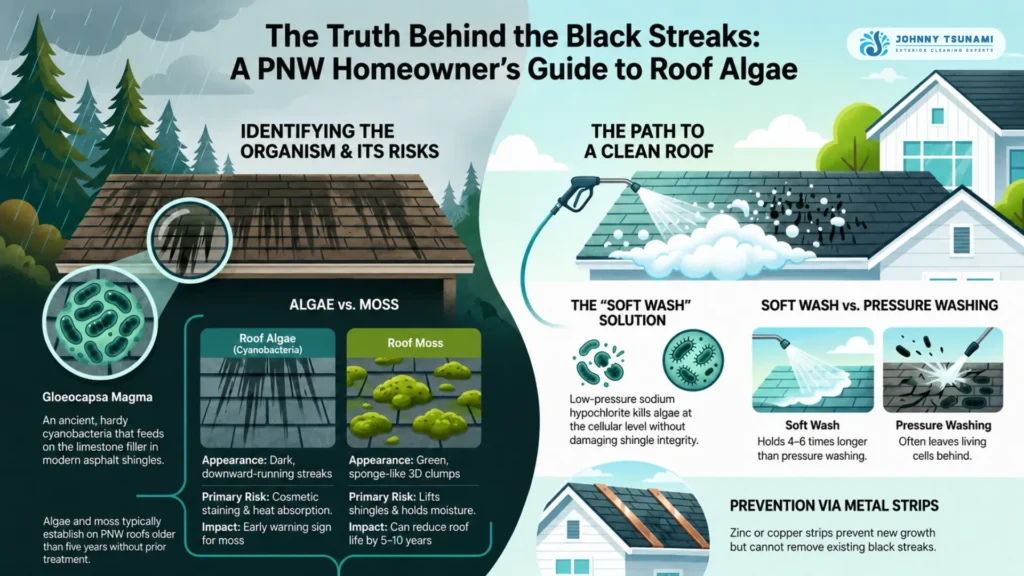
These are not the same problem. Algae is a thin biological film that streaks downward from gutter lines, ridges, and chimney bases. Moss is the three-dimensional, sponge-like growth that lifts shingle edges and holds moisture against the roof deck. Different organisms with different risks and different urgency. Most PNW roofs end up with both, which is why the conversation usually gets blurred.
Let’s walk through what algae actually is, what it does (and what it doesn’t do), what it tells you about the rest of your roof, and how to handle it.
What Is Gloeocapsa Magma
Promised payoff on the “life on Earth” claim: this algae (aka cyanobacteria) is ancient. Like, 2.4 billion years ancient. Current scientific consensus credits cyanobacteria with producing the oxygen that made Earth’s atmosphere breathable in the first place. So technically, we owe these little blue-green algae everything — and living on your shingles is how they repay us.
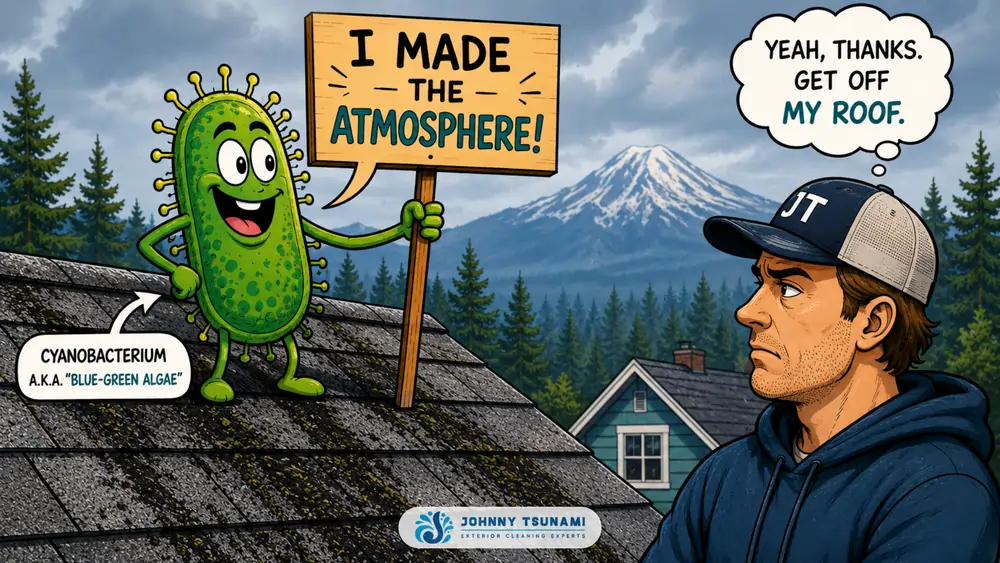
Back to the present. According to ARMA (the Asphalt Roofing Manufacturers Association), the algae feeds on the limestone filler used in most modern asphalt shingles. That sounds alarming, but ARMA has been equally clear that there’s no scientific evidence the feeding actually damages the shingle structurally. The dark sheath is what makes the streaks look black, and it’s also what makes algae stubborn to kill with anything other than the right chemical treatment. Pressure washing won’t penetrate the sheath. Garden-store roof cleaners reach the surface but rarely make it to the cells underneath.
Algae spreads through airborne spores. Once it sets up on one roof in a neighborhood, those spores travel to nearby homes through wind and rain. That’s why algae usually shows up on multiple homes on the same street within a year or two of the first house going visible. If you’ve noticed it on a neighbor’s roof, your own roof is probably next. Thanks a lot, neighbor.
Why It Shows Up Where It Shows Up
In the Pacific Northwest, roof algae establishes first on north-facing slopes because they get the least direct sun all day and hold moisture longest. Streak patterns follow three predictable drivers.
Moisture-holding exposures favor algae. Beyond the north-facing rule, roof valleys, sections shaded by trees, and the lower courses of shingles where ventilation is weakest all go first.
Streaks run downward from concentrated points. Chimneys and ridge lines are the two most common starting spots. Both collect water and channel it down across the shingles below. Think of it as a tiny waterway for algae to surf on, growing downward from wherever the water lingers.
Spore pressure rises with neighborhood density. Once an algae-positive roof shows up on a block, surrounding homes go visible within a year or two. Thanks Ted!
If your roof shows streaks below the chimney or running down from the ridge on a shaded slope, that’s textbook algae.
What Algae Is Actually Doing to Your Roof
In the Pacific Northwest, roof algae alone is mostly cosmetic. Visually, it’s ugly and darkening the roof can cause slightly more heat absorption, and over many years it contributes to slow surface granule wear. But on its own, algae is closer to a stain than a structural problem.
The reason PNW roofs still need attention when algae shows up is that algae rarely travels alone here. In our climate, algae is usually the early indicator that moss is right behind it. Same conditions, same north slopes, same shaded sections. And moss is the real damage.
Moss lifts shingle edges, holds moisture against the roof deck, and in worse cases, channels water sideways under the shingle layers. Industry research on roofs with prolonged moss establishment shows shingle life can drop by 5 to 10 years. And, ruh-roh, Roof replacement in the PNW runs $15,000 to $30,000!
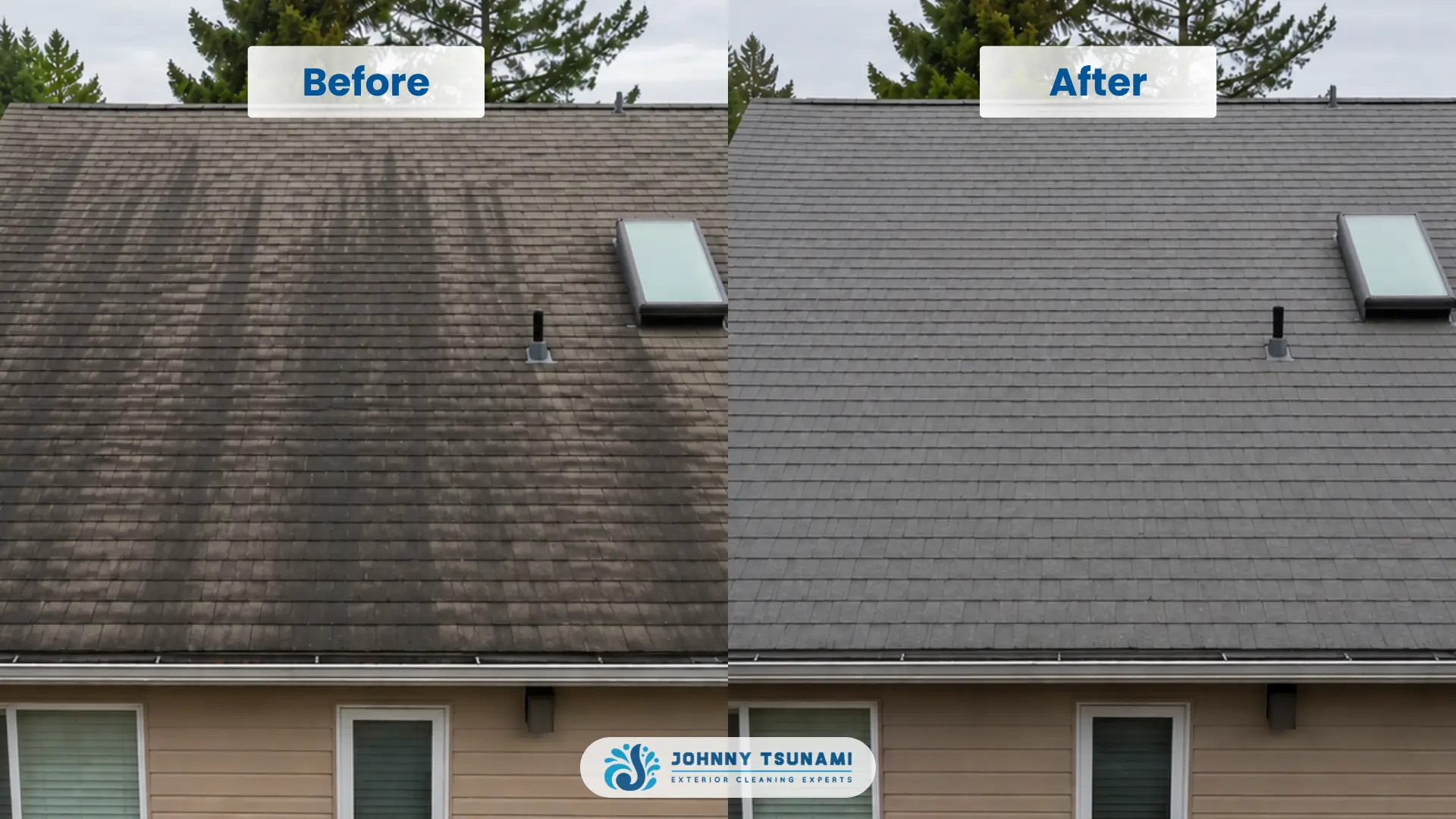
So when we say algae matters, the honest answer is: algae matters because it’s the visible signal that the conditions your roof is sitting in are also growing moss, often in the shaded spots you can’t see from the street. Treating the algae alone takes the cosmetic hit off the table. The bigger value is that an algae visit gets eyes on the roof to assess the moss situation before it becomes a roof replacement conversation.
What the Right Treatment Looks Like
In the Pacific Northwest, the correct treatment for roof cleaning is a soft wash using a low-pressure cleaning solution (the active ingredient is sodium hypochlorite, the same chemistry as household pool shock), which kills the organism at the cellular level. Per the Roof Cleaning Institute of America, soft wash treatment holds four to six times longer than pressure washing. Pressure washing is the wrong move, same as it’s the wrong move for moss. It damages shingles, forces water under the layers, and doesn’t penetrate the protective sheath, so the algae survives. Within a few months, the streaks are usually back, because pressure washing removes the visible film but leaves the living cells underneath.
After a proper soft wash, subsequent rain rinses the dead residue off the roof over the following weeks. Clean roof, protection that holds four to six times longer than pressure washing. Even longer if you and your neighbors tackle the problem together. Kumbaya.
After treating thousands of PNW roofs across the Seattle metro, the Johnny Tsunami team sees algae and moss travel together on the majority of roofs older than five years, which is why most professional crews handle both in one visit.
What About Zinc and Copper Strips
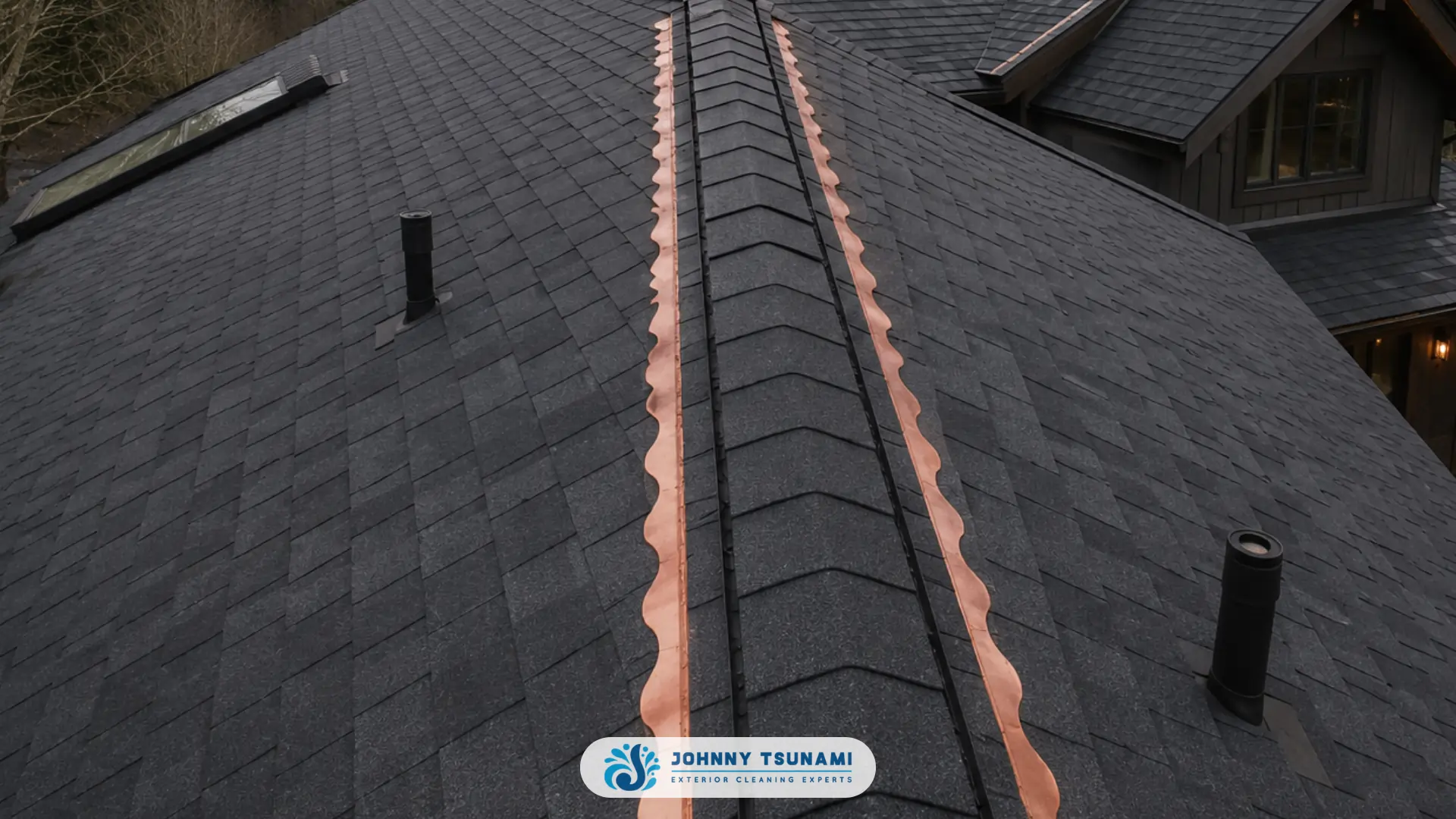
How they work, briefly: zinc and copper are both mildly toxic to algae spores and moss. When rain hits the metal strip at the ridge, it picks up trace amounts of the metal and carries those ions down the slope. The ions kill new spores before they can establish. Yes, they work on both algae and moss. Same mechanism.
What they don’t do: remove existing growth. If your roof is already streaked, you need to treat the existing growth first, then the strips can help slow regrowth on the cleaned surface.
Worth noting what most articles skip: these strips depend entirely on rainwater runoff to work. Closer to the ridge, the more effective…but by the lower courses of a tall roof, the metal concentration has dropped enough that protection is partial at best. Useful as an add-on after a cleaned roof, not a replacement for periodic treatment.
How to Tell If Your Roof Needs Treatment
In the Pacific Northwest, three signals indicate a roof needs algae treatment: visible black streaks on north-facing slopes, excessive granule accumulation in the gutters, and a roof over five years old with no prior treatment.
Black streaks running down from chimneys or ridges mean algae is already established. Excessive granule accumulation in your gutters (more than a roof normally sheds) usually means moss is accelerating shingle wear, and algae is probably nearby. And if your roof is over five years old and has never been treated, algae is almost certainly present, even if the streaking isn’t visible from the street yet.
If any of those signs are clear, late spring through early fall is the operational window in the PNW. Soft wash solution works best in dry weather between rain bands, and bookings tighten as Memorial Day weekend approaches.
Frequently Asked Questions
Q: What causes black streaks on a roof?
A: The streaks are an algae called Gloeocapsa magma, a cyanobacteria that establishes on shaded roof slopes (most often north-facing in the PNW) and produces a dark protective sheath. That sheath is what creates the visible streaking. It’s an organism, not dirt or staining.
Q: How is roof algae different from moss?
A: Moss is three-dimensional sponge-like growth that lifts shingle edges and holds moisture against the roof deck. Algae is a thin film that streaks downward from gutters, ridges, and chimneys. Both can be present on the same roof but they’re different organisms with different damage profiles.
Q: Are black streaks on my roof actually damaging the shingles?
A: Algae alone is mostly cosmetic. According to ARMA and Malarkey, there’s no scientific evidence algae structurally damages shingles. In the PNW though, it rarely travels alone — it’s usually the early visible signal that moss is establishing in the same conditions, and moss is the organism that shortens shingle life.
Q: Can I pressure wash algae off my roof?
A: No. Pressure washing damages shingles, forces water under the layers, and doesn’t penetrate the protective sheath the algae produces, so the algae survives. Most pressure-washed roofs are streaked again within a few months. It also gets worse: most asphalt shingle manufacturer warranties specifically exclude damage from pressure washing, so a single DIY pass can void coverage on the rest of your roof’s lifespan. A proper soft wash treatment is the correct method.
Prevention, Maintenance & DIY
Q: Will the algae come back after treatment?
A: Not for years if it’s a proper soft wash. Per the Roof Cleaning Institute of America, soft wash treatment holds four to six times longer than pressure washing. Its chemistry kills the organism at the cellular level, and rain rinses the dead residue off the roof over the following weeks. Pressure-washed roofs, by contrast, usually show streaks again within a single rainy season because the visible film comes off but the living cells underneath survive.
Q: How often do I need to clean my PNW roof?
A: For most PNW homes on a soft wash schedule, every few years works. Heavy tree cover, deep shade, or a moss-prone slope can push that interval shorter. Roofs that haven’t been treated in five-plus years usually need physical moss removal in addition to the algae soft wash.
Zinc Strips, DIY & Roof Age
Q: Do zinc and copper strips actually work?
A: Yes, but only for prevention, not removal. The strips slow new algae and moss growth by releasing metal ions in rainwater runoff. Most effective near the top of the slope, with weaker coverage on lower courses. A useful add-on after a roof has been treated — not a substitute for periodic treatment.
Treating Algae Yourself
Q: Can I treat algae on my roof myself?
A: Walking a wet PNW roof carries real fall risk, and roof-specific cleaning products need careful dilution to avoid damaging shingles or surrounding landscaping. Going DIY anyway? Use a proper harness and stable ladder positioning — not a trampoline or a mattress to bounce you back up if you fall. (Looking at you, Uncle Chris.) For most homeowners, professional treatment is the safer call and holds up longer than over-the-counter options.
Black streaks on north-facing slopes — especially running down from a chimney or ridge line — mean algae is established. The streaks themselves are mostly cosmetic, but in the PNW they’re usually a leading indicator that moss is setting up in the same shaded sections. Soft wash treatment handles both, and gets eyes on the roof before moss damage becomes a roof replacement conversation.
We service the Seattle metro and Kitsap County. Pacific Northwest’s most reviewed exterior cleaning company, with 3,000+ five-star reviews.
We serve the Pacific Northwest. A quote takes 60 seconds. No obligation.
[Get a Free Quote] — johnnytsunami.com/quote | Call or text (360) 440-6301